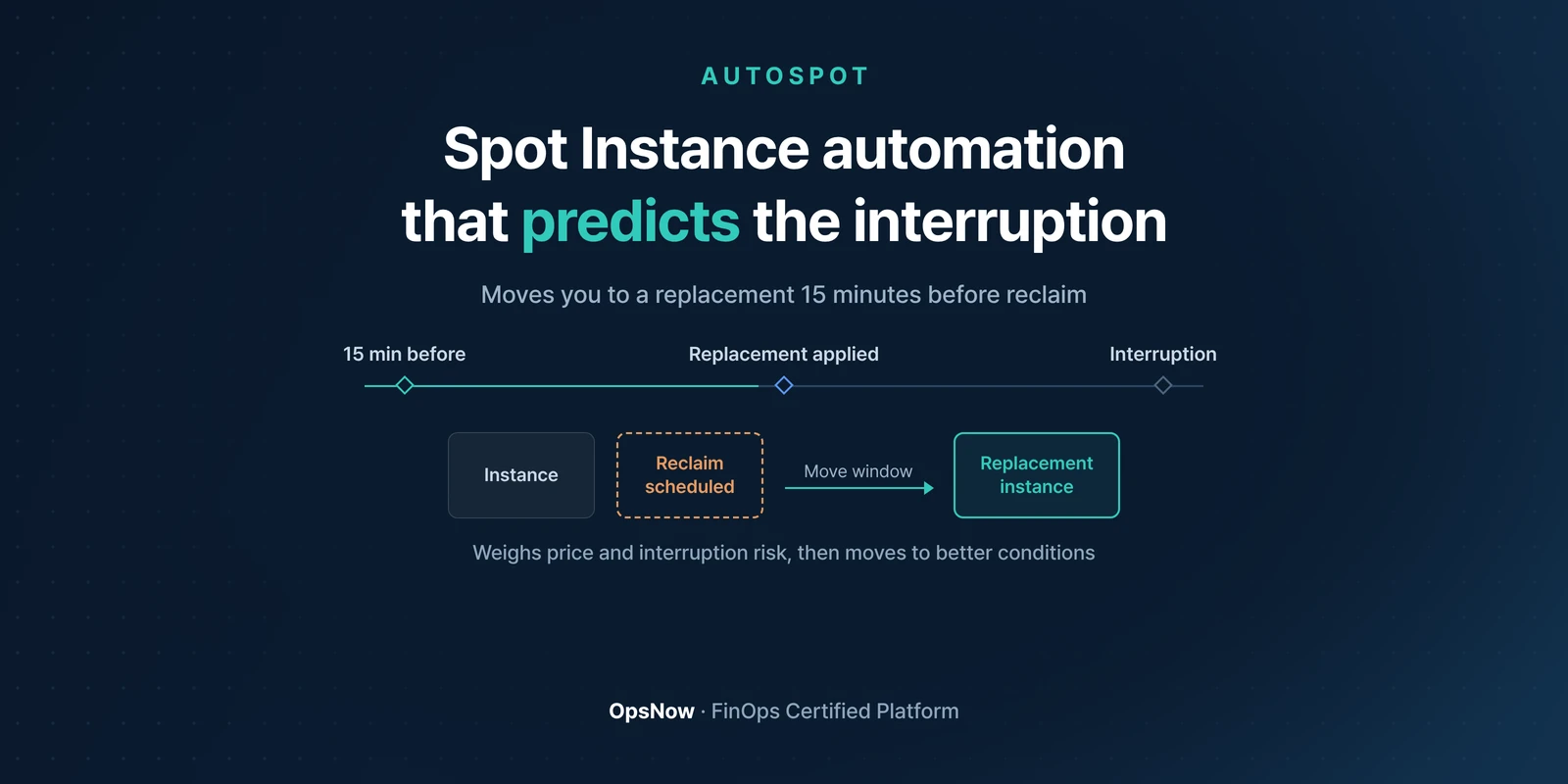
AutoSpot: detecting an interruption 15 minutes ahead and moving to a replacement instance
Products

AutoSpot: Spot Instance Automation That Predicts Interruptions

OpsNow Team
2026-09-22

■ Problem: Spot Instances cost up to 90% less than on-demand. But the moment an interruption notice arrives, the workload stops, so few teams trust them in production.

■ Solution: AutoSpot, a Spot Instance automation tool, handles instance selection and interruption response. Machine learning predicts interruptions up to 15 minutes ahead and moves workloads to replacement instances in that window.

■ Result: You run on Spot while keeping a 99.99% SLA. E-commerce company O moved half of its EC2 fleet to Spot and cut the related cost by 70%.

A batch job running on Friday night died when its Spot capacity was reclaimed. There was no restart logic, so it sat stopped until Monday morning. That team still uses Spot only for development.

The assumption that cheap means interrupted

Spot is how cloud providers sell spare capacity at a discount. AWS lists the discount as up to 90% off on-demand. Because it's spare capacity, it can be reclaimed at any time. Most people know this much.

The trouble starts after that. To handle interruptions, you have to make workloads stateless, catch the interruption signal and shut down cleanly, maintain a list of fallback instance types, and keep an eye on interruption rates by type. Few teams have an engineer who can own that full time. So Spot usually stops at dev and test.

What Spot Instance automation watches for you

AutoSpot takes these judgment calls off your plate. It weighs price and interruption risk together and applies the best Spot option in real time. It isn't tied to one instance type and keeps switching to whatever offers better conditions at the moment.

Prediction is the core. A machine learning model reads the signs of an upcoming interruption and gives notice up to 15 minutes ahead. If you wait for the interruption notice, there's barely time to shut down. With 15 minutes in hand, you can launch a new instance, shift traffic and drain the old one without rushing.

A common setup covers steady usage with commitments and handles the variable part with Spot. AutoSavings takes care of the commitment side.
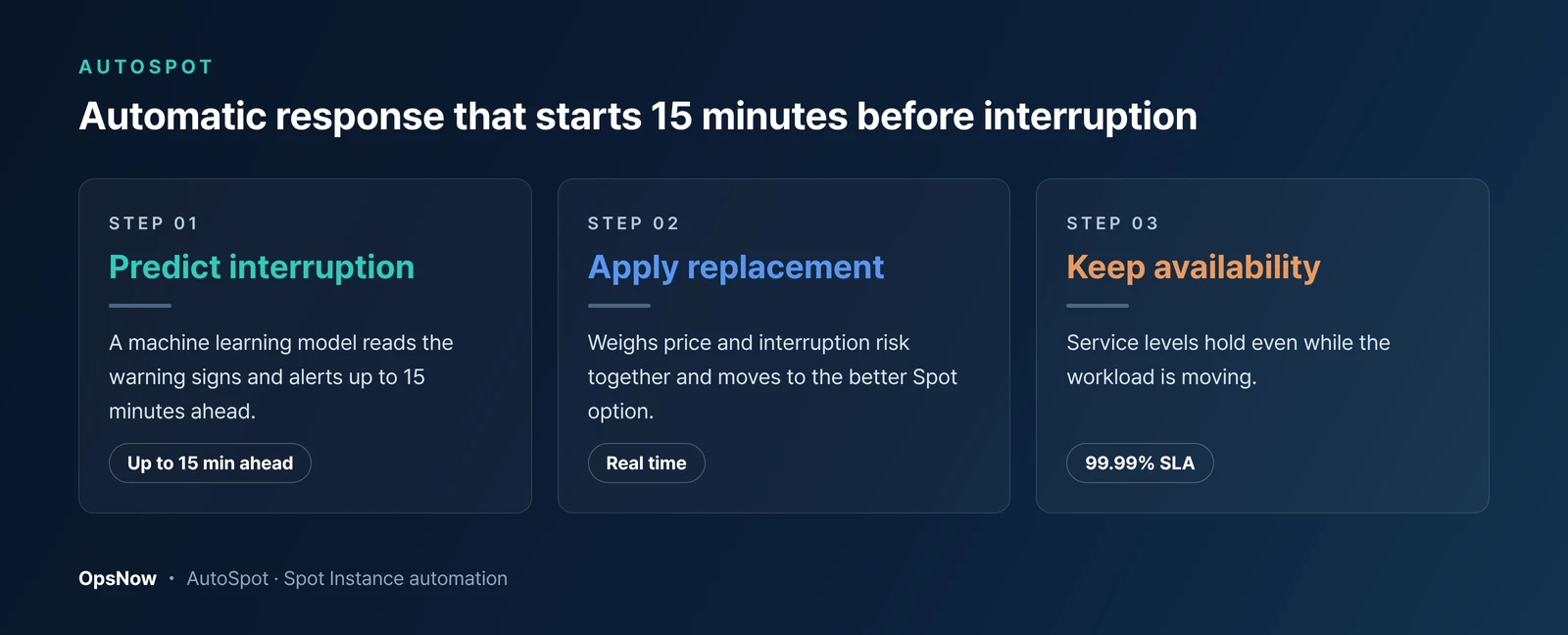
Three-step diagram of AutoSpot predicting an interruption 15 minutes ahead, moving to a replacement instance and keeping a 99.99% SLA
From predicting the interruption to applying the replacement, no one has to step in.

A real-world example

E-commerce company O moved half of its EC2 instances to Spot. The related cost dropped 70%, and availability held at 99.99%. This is a real customer case, and results vary with workload design.

AutoSpot itself comes with a 99.99% SLA. What holds teams back from Spot isn't doubt about the savings but worry about availability, so evaluations usually start with that number.

Workloads where nodes can change freely, such as batch jobs, CI runners and stateless API servers, are the first candidates. If licenses are tied to instances or data piles up on local disks, move those later.

Back to that batch job. If someone had known about the interruption 15 minutes ahead, there would have been nothing to check on Monday morning. Before deciding whether to use Spot, decide who will watch for interruptions.

▶ Talk to OpsNow about your cloud costs

Frequently Asked Questions

Q. Can production workloads run on Spot?

Yes. AutoSpot is offered with a 99.99% SLA and predicts interruptions up to 15 minutes ahead so replacements happen in advance. If a workload stores state on the instance, though, its architecture needs work first.

Q. How much can we save?

Spot pricing itself is up to 90% below on-demand (per AWS). E-commerce company O moved half of its EC2 to Spot and cut the related cost by 70%. That's a real customer case, and the savings depend on your setup.

Q. What if the prediction window gets shorter?

Prediction aims for up to 15 minutes ahead. Even when the window is shorter, replacement Spot capacity is applied in real time, and service levels are managed under a 99.99% SLA.

Get Started Today with OpsNow

AutoSpot: detecting an interruption 15 minutes ahead and moving to a replacement instance
Products

AutoSpot: Spot Instance Automation That Predicts Interruptions

OpsNow Team
2026-09-22

■ Problem: Spot Instances cost up to 90% less than on-demand. But the moment an interruption notice arrives, the workload stops, so few teams trust them in production.

■ Solution: AutoSpot, a Spot Instance automation tool, handles instance selection and interruption response. Machine learning predicts interruptions up to 15 minutes ahead and moves workloads to replacement instances in that window.

■ Result: You run on Spot while keeping a 99.99% SLA. E-commerce company O moved half of its EC2 fleet to Spot and cut the related cost by 70%.

A batch job running on Friday night died when its Spot capacity was reclaimed. There was no restart logic, so it sat stopped until Monday morning. That team still uses Spot only for development.

The assumption that cheap means interrupted

Spot is how cloud providers sell spare capacity at a discount. AWS lists the discount as up to 90% off on-demand. Because it's spare capacity, it can be reclaimed at any time. Most people know this much.

The trouble starts after that. To handle interruptions, you have to make workloads stateless, catch the interruption signal and shut down cleanly, maintain a list of fallback instance types, and keep an eye on interruption rates by type. Few teams have an engineer who can own that full time. So Spot usually stops at dev and test.

What Spot Instance automation watches for you

AutoSpot takes these judgment calls off your plate. It weighs price and interruption risk together and applies the best Spot option in real time. It isn't tied to one instance type and keeps switching to whatever offers better conditions at the moment.

Prediction is the core. A machine learning model reads the signs of an upcoming interruption and gives notice up to 15 minutes ahead. If you wait for the interruption notice, there's barely time to shut down. With 15 minutes in hand, you can launch a new instance, shift traffic and drain the old one without rushing.

A common setup covers steady usage with commitments and handles the variable part with Spot. AutoSavings takes care of the commitment side.

Three-step diagram of AutoSpot predicting an interruption 15 minutes ahead, moving to a replacement instance and keeping a 99.99% SLA
From predicting the interruption to applying the replacement, no one has to step in.

A real-world example

E-commerce company O moved half of its EC2 instances to Spot. The related cost dropped 70%, and availability held at 99.99%. This is a real customer case, and results vary with workload design.

AutoSpot itself comes with a 99.99% SLA. What holds teams back from Spot isn't doubt about the savings but worry about availability, so evaluations usually start with that number.

Workloads where nodes can change freely, such as batch jobs, CI runners and stateless API servers, are the first candidates. If licenses are tied to instances or data piles up on local disks, move those later.

Back to that batch job. If someone had known about the interruption 15 minutes ahead, there would have been nothing to check on Monday morning. Before deciding whether to use Spot, decide who will watch for interruptions.

▶ Talk to OpsNow about your cloud costs

Frequently Asked Questions

Q. Can production workloads run on Spot?

Yes. AutoSpot is offered with a 99.99% SLA and predicts interruptions up to 15 minutes ahead so replacements happen in advance. If a workload stores state on the instance, though, its architecture needs work first.

Q. How much can we save?

Spot pricing itself is up to 90% below on-demand (per AWS). E-commerce company O moved half of its EC2 to Spot and cut the related cost by 70%. That's a real customer case, and the savings depend on your setup.

Q. What if the prediction window gets shorter?

Prediction aims for up to 15 minutes ahead. Even when the window is shorter, replacement Spot capacity is applied in real time, and service levels are managed under a 99.99% SLA.

AutoSpot: Spot Instance Automation That Predicts Interruptions

■ Problem: Spot Instances cost up to 90% less than on-demand. But the moment an interruption notice arrives, the workload stops, so few teams trust them in production.

■ Solution: AutoSpot, a Spot Instance automation tool, handles instance selection and interruption response. Machine learning predicts interruptions up to 15 minutes ahead and moves workloads to replacement instances in that window.

■ Result: You run on Spot while keeping a 99.99% SLA. E-commerce company O moved half of its EC2 fleet to Spot and cut the related cost by 70%.

A batch job running on Friday night died when its Spot capacity was reclaimed. There was no restart logic, so it sat stopped until Monday morning. That team still uses Spot only for development.

The assumption that cheap means interrupted

Spot is how cloud providers sell spare capacity at a discount. AWS lists the discount as up to 90% off on-demand. Because it's spare capacity, it can be reclaimed at any time. Most people know this much.

The trouble starts after that. To handle interruptions, you have to make workloads stateless, catch the interruption signal and shut down cleanly, maintain a list of fallback instance types, and keep an eye on interruption rates by type. Few teams have an engineer who can own that full time. So Spot usually stops at dev and test.

What Spot Instance automation watches for you

AutoSpot takes these judgment calls off your plate. It weighs price and interruption risk together and applies the best Spot option in real time. It isn't tied to one instance type and keeps switching to whatever offers better conditions at the moment.

Prediction is the core. A machine learning model reads the signs of an upcoming interruption and gives notice up to 15 minutes ahead. If you wait for the interruption notice, there's barely time to shut down. With 15 minutes in hand, you can launch a new instance, shift traffic and drain the old one without rushing.

A common setup covers steady usage with commitments and handles the variable part with Spot. AutoSavings takes care of the commitment side.

Three-step diagram of AutoSpot predicting an interruption 15 minutes ahead, moving to a replacement instance and keeping a 99.99% SLA
From predicting the interruption to applying the replacement, no one has to step in.

A real-world example

E-commerce company O moved half of its EC2 instances to Spot. The related cost dropped 70%, and availability held at 99.99%. This is a real customer case, and results vary with workload design.

AutoSpot itself comes with a 99.99% SLA. What holds teams back from Spot isn't doubt about the savings but worry about availability, so evaluations usually start with that number.

Workloads where nodes can change freely, such as batch jobs, CI runners and stateless API servers, are the first candidates. If licenses are tied to instances or data piles up on local disks, move those later.

Back to that batch job. If someone had known about the interruption 15 minutes ahead, there would have been nothing to check on Monday morning. Before deciding whether to use Spot, decide who will watch for interruptions.

▶ Talk to OpsNow about your cloud costs

Frequently Asked Questions

Q. Can production workloads run on Spot?

Yes. AutoSpot is offered with a 99.99% SLA and predicts interruptions up to 15 minutes ahead so replacements happen in advance. If a workload stores state on the instance, though, its architecture needs work first.

Q. How much can we save?

Spot pricing itself is up to 90% below on-demand (per AWS). E-commerce company O moved half of its EC2 to Spot and cut the related cost by 70%. That's a real customer case, and the savings depend on your setup.

Q. What if the prediction window gets shorter?

Prediction aims for up to 15 minutes ahead. Even when the window is shorter, replacement Spot capacity is applied in real time, and service levels are managed under a 99.99% SLA.

Download it for free
Submit the information below and get the files you need right away
Name *
Company *
Business Email *
By registering an inquiry, you agree to allow OpsNow to store and process your information for contact purposes.
Please read our Privacy Policy for more information.
Thank you.
The file has been downloaded.
Please enter all required fields.
AutoSpot: detecting an interruption 15 minutes ahead and moving to a replacement instance

AutoSpot: Spot Instance Automation That Predicts Interruptions

OpsNow Team
2026-09-22

■ Problem: Spot Instances cost up to 90% less than on-demand. But the moment an interruption notice arrives, the workload stops, so few teams trust them in production.

■ Solution: AutoSpot, a Spot Instance automation tool, handles instance selection and interruption response. Machine learning predicts interruptions up to 15 minutes ahead and moves workloads to replacement instances in that window.

■ Result: You run on Spot while keeping a 99.99% SLA. E-commerce company O moved half of its EC2 fleet to Spot and cut the related cost by 70%.

A batch job running on Friday night died when its Spot capacity was reclaimed. There was no restart logic, so it sat stopped until Monday morning. That team still uses Spot only for development.

The assumption that cheap means interrupted

Spot is how cloud providers sell spare capacity at a discount. AWS lists the discount as up to 90% off on-demand. Because it's spare capacity, it can be reclaimed at any time. Most people know this much.

The trouble starts after that. To handle interruptions, you have to make workloads stateless, catch the interruption signal and shut down cleanly, maintain a list of fallback instance types, and keep an eye on interruption rates by type. Few teams have an engineer who can own that full time. So Spot usually stops at dev and test.

What Spot Instance automation watches for you

AutoSpot takes these judgment calls off your plate. It weighs price and interruption risk together and applies the best Spot option in real time. It isn't tied to one instance type and keeps switching to whatever offers better conditions at the moment.

Prediction is the core. A machine learning model reads the signs of an upcoming interruption and gives notice up to 15 minutes ahead. If you wait for the interruption notice, there's barely time to shut down. With 15 minutes in hand, you can launch a new instance, shift traffic and drain the old one without rushing.

A common setup covers steady usage with commitments and handles the variable part with Spot. AutoSavings takes care of the commitment side.

Three-step diagram of AutoSpot predicting an interruption 15 minutes ahead, moving to a replacement instance and keeping a 99.99% SLA
From predicting the interruption to applying the replacement, no one has to step in.

A real-world example

E-commerce company O moved half of its EC2 instances to Spot. The related cost dropped 70%, and availability held at 99.99%. This is a real customer case, and results vary with workload design.

AutoSpot itself comes with a 99.99% SLA. What holds teams back from Spot isn't doubt about the savings but worry about availability, so evaluations usually start with that number.

Workloads where nodes can change freely, such as batch jobs, CI runners and stateless API servers, are the first candidates. If licenses are tied to instances or data piles up on local disks, move those later.

Back to that batch job. If someone had known about the interruption 15 minutes ahead, there would have been nothing to check on Monday morning. Before deciding whether to use Spot, decide who will watch for interruptions.

▶ Talk to OpsNow about your cloud costs

Frequently Asked Questions

Q. Can production workloads run on Spot?

Yes. AutoSpot is offered with a 99.99% SLA and predicts interruptions up to 15 minutes ahead so replacements happen in advance. If a workload stores state on the instance, though, its architecture needs work first.

Q. How much can we save?

Spot pricing itself is up to 90% below on-demand (per AWS). E-commerce company O moved half of its EC2 to Spot and cut the related cost by 70%. That's a real customer case, and the savings depend on your setup.

Q. What if the prediction window gets shorter?

Prediction aims for up to 15 minutes ahead. Even when the window is shorter, replacement Spot capacity is applied in real time, and service levels are managed under a 99.99% SLA.

AutoSpot: Spot Instance Automation That Predicts Interruptions

OpsNow Team
2026-09-22

■ Problem: Spot Instances cost up to 90% less than on-demand. But the moment an interruption notice arrives, the workload stops, so few teams trust them in production.

■ Solution: AutoSpot, a Spot Instance automation tool, handles instance selection and interruption response. Machine learning predicts interruptions up to 15 minutes ahead and moves workloads to replacement instances in that window.

■ Result: You run on Spot while keeping a 99.99% SLA. E-commerce company O moved half of its EC2 fleet to Spot and cut the related cost by 70%.

A batch job running on Friday night died when its Spot capacity was reclaimed. There was no restart logic, so it sat stopped until Monday morning. That team still uses Spot only for development.

The assumption that cheap means interrupted

Spot is how cloud providers sell spare capacity at a discount. AWS lists the discount as up to 90% off on-demand. Because it's spare capacity, it can be reclaimed at any time. Most people know this much.

The trouble starts after that. To handle interruptions, you have to make workloads stateless, catch the interruption signal and shut down cleanly, maintain a list of fallback instance types, and keep an eye on interruption rates by type. Few teams have an engineer who can own that full time. So Spot usually stops at dev and test.

What Spot Instance automation watches for you

AutoSpot takes these judgment calls off your plate. It weighs price and interruption risk together and applies the best Spot option in real time. It isn't tied to one instance type and keeps switching to whatever offers better conditions at the moment.

Prediction is the core. A machine learning model reads the signs of an upcoming interruption and gives notice up to 15 minutes ahead. If you wait for the interruption notice, there's barely time to shut down. With 15 minutes in hand, you can launch a new instance, shift traffic and drain the old one without rushing.

A common setup covers steady usage with commitments and handles the variable part with Spot. AutoSavings takes care of the commitment side.

Three-step diagram of AutoSpot predicting an interruption 15 minutes ahead, moving to a replacement instance and keeping a 99.99% SLA
From predicting the interruption to applying the replacement, no one has to step in.

A real-world example

E-commerce company O moved half of its EC2 instances to Spot. The related cost dropped 70%, and availability held at 99.99%. This is a real customer case, and results vary with workload design.

AutoSpot itself comes with a 99.99% SLA. What holds teams back from Spot isn't doubt about the savings but worry about availability, so evaluations usually start with that number.

Workloads where nodes can change freely, such as batch jobs, CI runners and stateless API servers, are the first candidates. If licenses are tied to instances or data piles up on local disks, move those later.

Back to that batch job. If someone had known about the interruption 15 minutes ahead, there would have been nothing to check on Monday morning. Before deciding whether to use Spot, decide who will watch for interruptions.

▶ Talk to OpsNow about your cloud costs

Frequently Asked Questions

Q. Can production workloads run on Spot?

Yes. AutoSpot is offered with a 99.99% SLA and predicts interruptions up to 15 minutes ahead so replacements happen in advance. If a workload stores state on the instance, though, its architecture needs work first.

Q. How much can we save?

Spot pricing itself is up to 90% below on-demand (per AWS). E-commerce company O moved half of its EC2 to Spot and cut the related cost by 70%. That's a real customer case, and the savings depend on your setup.

Q. What if the prediction window gets shorter?

Prediction aims for up to 15 minutes ahead. Even when the window is shorter, replacement Spot capacity is applied in real time, and service levels are managed under a 99.99% SLA.

AutoSpot: detecting an interruption 15 minutes ahead and moving to a replacement instance
Products

AutoSpot: Spot Instance Automation That Predicts Interruptions

OpsNow Team
2026-09-22

■ Problem: Spot Instances cost up to 90% less than on-demand. But the moment an interruption notice arrives, the workload stops, so few teams trust them in production.

■ Solution: AutoSpot, a Spot Instance automation tool, handles instance selection and interruption response. Machine learning predicts interruptions up to 15 minutes ahead and moves workloads to replacement instances in that window.

■ Result: You run on Spot while keeping a 99.99% SLA. E-commerce company O moved half of its EC2 fleet to Spot and cut the related cost by 70%.

A batch job running on Friday night died when its Spot capacity was reclaimed. There was no restart logic, so it sat stopped until Monday morning. That team still uses Spot only for development.

The assumption that cheap means interrupted

Spot is how cloud providers sell spare capacity at a discount. AWS lists the discount as up to 90% off on-demand. Because it's spare capacity, it can be reclaimed at any time. Most people know this much.

The trouble starts after that. To handle interruptions, you have to make workloads stateless, catch the interruption signal and shut down cleanly, maintain a list of fallback instance types, and keep an eye on interruption rates by type. Few teams have an engineer who can own that full time. So Spot usually stops at dev and test.

What Spot Instance automation watches for you

AutoSpot takes these judgment calls off your plate. It weighs price and interruption risk together and applies the best Spot option in real time. It isn't tied to one instance type and keeps switching to whatever offers better conditions at the moment.

Prediction is the core. A machine learning model reads the signs of an upcoming interruption and gives notice up to 15 minutes ahead. If you wait for the interruption notice, there's barely time to shut down. With 15 minutes in hand, you can launch a new instance, shift traffic and drain the old one without rushing.

A common setup covers steady usage with commitments and handles the variable part with Spot. AutoSavings takes care of the commitment side.

Three-step diagram of AutoSpot predicting an interruption 15 minutes ahead, moving to a replacement instance and keeping a 99.99% SLA
From predicting the interruption to applying the replacement, no one has to step in.

A real-world example

E-commerce company O moved half of its EC2 instances to Spot. The related cost dropped 70%, and availability held at 99.99%. This is a real customer case, and results vary with workload design.

AutoSpot itself comes with a 99.99% SLA. What holds teams back from Spot isn't doubt about the savings but worry about availability, so evaluations usually start with that number.

Workloads where nodes can change freely, such as batch jobs, CI runners and stateless API servers, are the first candidates. If licenses are tied to instances or data piles up on local disks, move those later.

Back to that batch job. If someone had known about the interruption 15 minutes ahead, there would have been nothing to check on Monday morning. Before deciding whether to use Spot, decide who will watch for interruptions.

▶ Talk to OpsNow about your cloud costs

Frequently Asked Questions

Q. Can production workloads run on Spot?

Yes. AutoSpot is offered with a 99.99% SLA and predicts interruptions up to 15 minutes ahead so replacements happen in advance. If a workload stores state on the instance, though, its architecture needs work first.

Q. How much can we save?

Spot pricing itself is up to 90% below on-demand (per AWS). E-commerce company O moved half of its EC2 to Spot and cut the related cost by 70%. That's a real customer case, and the savings depend on your setup.

Q. What if the prediction window gets shorter?

Prediction aims for up to 15 minutes ahead. Even when the window is shorter, replacement Spot capacity is applied in real time, and service levels are managed under a 99.99% SLA.