■ Problem: The FOCUS standard is bringing billing column names into line across cloud providers, but each provider exports a different FOCUS version and leaves different columns incomplete.
■ Solution: Before merging data, list each provider's FOCUS version and conformance gaps in one table, and decide which cost column your reports will use.
■ Result: The per-CSP column mapping sheet you used to patch every month becomes a single version table you update only when a provider moves to a new version.
Two days before the month-end report was due, the analyst merging billing files from three clouds into one sheet found two different amounts for the same service in the same month. One included commitment discounts. The other didn't. The column names gave no hint which was which. That is exactly the scene the FOCUS standard is aimed at.
FOCUS (FinOps Open Cost and Usage Specification) is an open specification that sets billing column names and definitions independent of any provider. It is supported by the FinOps Foundation. The specification's introduction notes that providers have relied on proprietary billing schemas and inconsistent terminology, leaving practitioners to build their own normalization for each provider.
FOCUS data carries Billed Cost and Effective Cost side by side. Billed Cost is the amount on the invoice. Effective Cost reflects discounts plus the applicable portion of prepaid commitments that covered the charge. The two amounts from the opening scene each get their own name.
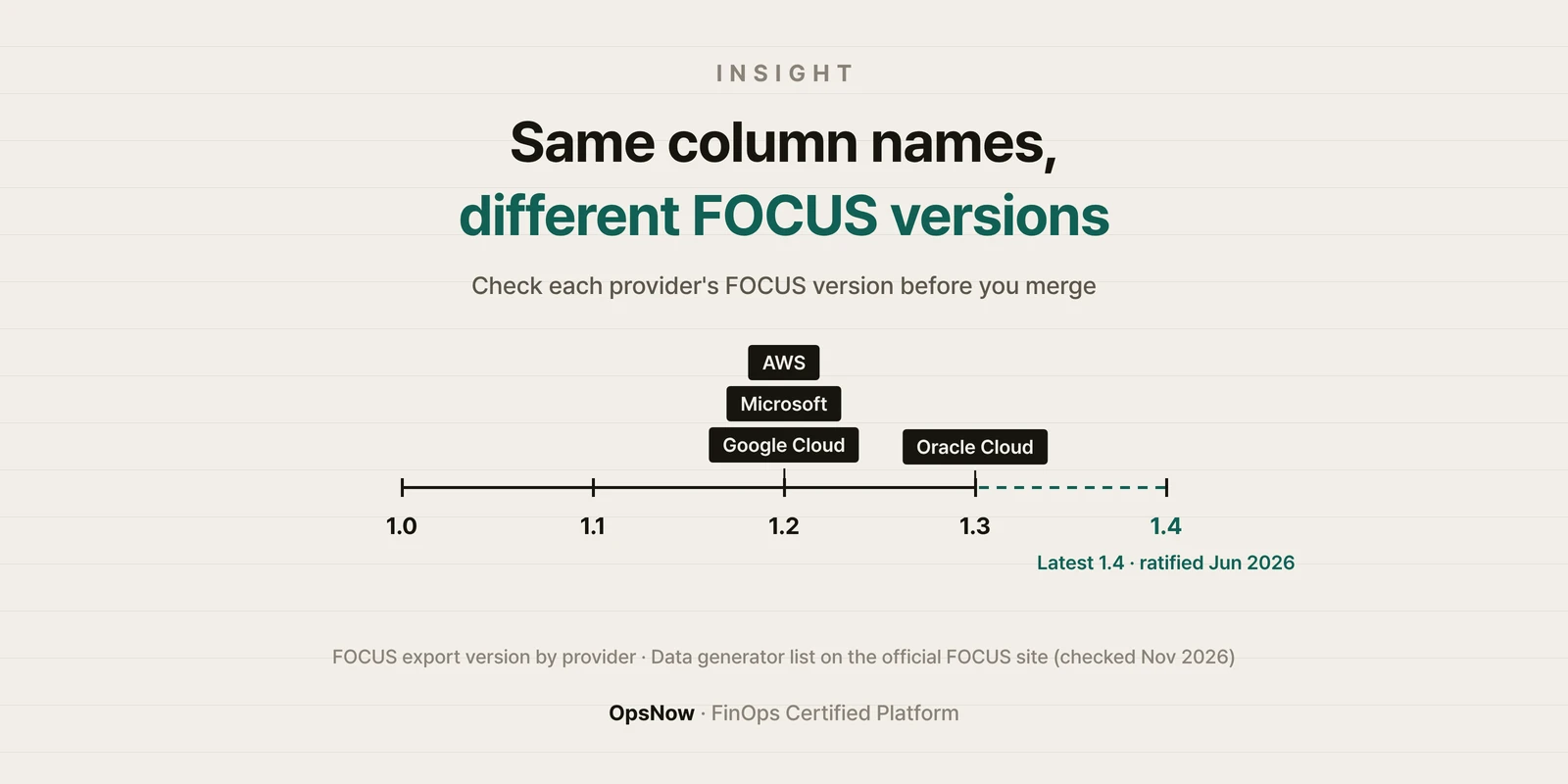
The data generator list on the official FOCUS site shows AWS, Microsoft and Google Cloud exporting in FOCUS 1.2, and Oracle Cloud in 1.3 (checked November 2026).
The latest specification is 1.4, ratified on June 4, 2026. It adds Invoice Detail and Billing Period datasets for reconciling usage against invoices, which current provider exports may not include yet.
Gaps show up within a single version too. AWS publishes a separate page of conformance gaps for its FOCUS 1.2 export. One example: for services with a minimum charge quantity, Consumed Quantity may hold the amount you were charged for rather than the amount you actually used.
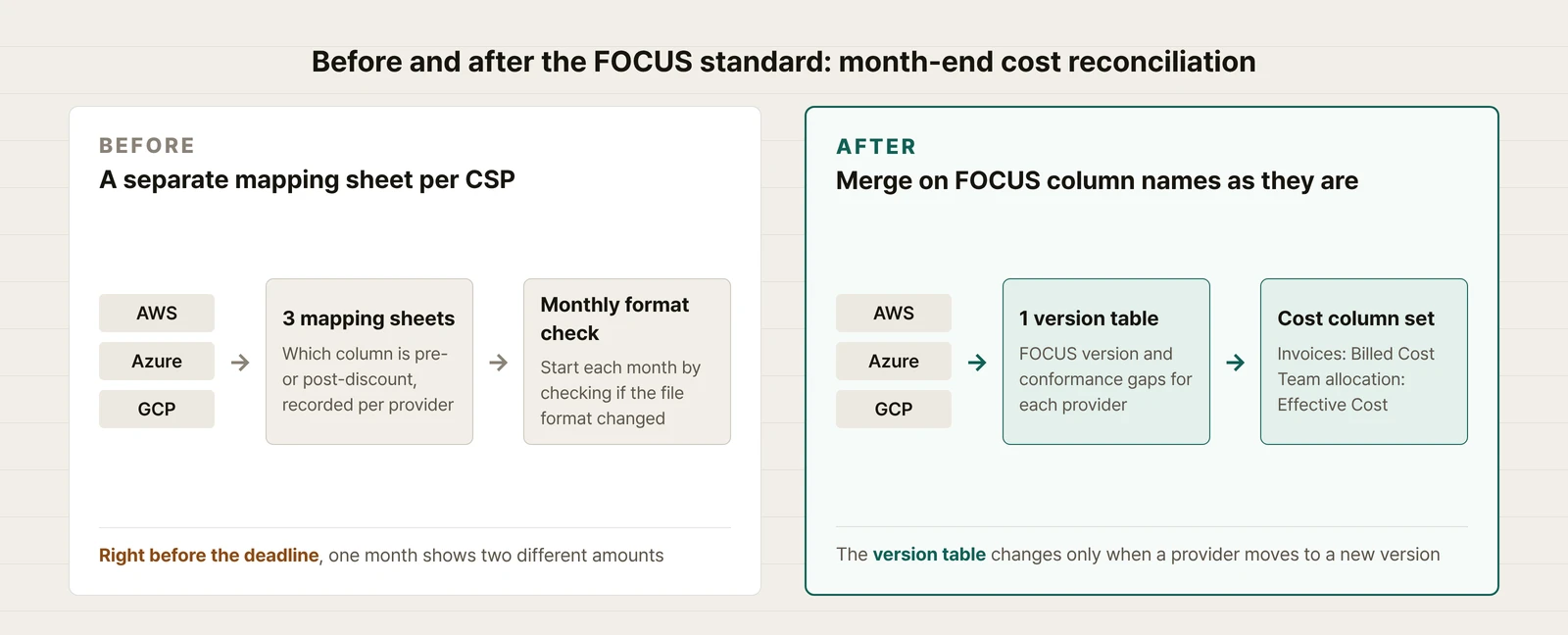
Before, the analyst keeps a separate column mapping sheet for each CSP. It records which column is pre-discount and which is post-discount for each provider, and every month starts with checking whether the file format has changed.
After, each CSP's data comes in FOCUS format and is merged on the column names as they are. Instead of mapping sheets, there is one table listing each provider's version and conformance gaps. The report also decides up front whether it uses Billed Cost or Effective Cost, so amounts are far less likely to split in two right before the deadline.
If you run on several CSPs, building this table goes hand in hand with bringing costs onto one baseline. OpsNow brings costs from five CSPs, AWS, Azure, GCP, OCI and Naver Cloud, into one place, the most of any platform in Korea.
What the analyst needed two days before the deadline was not a more detailed mapping sheet. It was a name for each of the two amounts, and one line saying which one goes in the report.
▶ Talk to OpsNow about your cloud costs
It is an open specification that aligns billing data from cloud, SaaS and other providers to the same column names and definitions. The full name is FinOps Open Cost and Usage Specification, and it is supported by the FinOps Foundation.
It reduces it, but doesn't remove it. Providers support different versions, and some, like AWS, publish their own conformance gaps, so those items still need checking.
Billed Cost is the amount on the invoice. Effective Cost reflects discounts and the applicable portion of prepaid commitments, so the two values differ in accounts that have commitments.
Check which version your providers export first. FOCUS 1.4 was ratified in June 2026, and the AWS, Microsoft and Google Cloud exports are still in the 1.2 format.

■ Problem: The FOCUS standard is bringing billing column names into line across cloud providers, but each provider exports a different FOCUS version and leaves different columns incomplete.
■ Solution: Before merging data, list each provider's FOCUS version and conformance gaps in one table, and decide which cost column your reports will use.
■ Result: The per-CSP column mapping sheet you used to patch every month becomes a single version table you update only when a provider moves to a new version.
Two days before the month-end report was due, the analyst merging billing files from three clouds into one sheet found two different amounts for the same service in the same month. One included commitment discounts. The other didn't. The column names gave no hint which was which. That is exactly the scene the FOCUS standard is aimed at.
FOCUS (FinOps Open Cost and Usage Specification) is an open specification that sets billing column names and definitions independent of any provider. It is supported by the FinOps Foundation. The specification's introduction notes that providers have relied on proprietary billing schemas and inconsistent terminology, leaving practitioners to build their own normalization for each provider.
FOCUS data carries Billed Cost and Effective Cost side by side. Billed Cost is the amount on the invoice. Effective Cost reflects discounts plus the applicable portion of prepaid commitments that covered the charge. The two amounts from the opening scene each get their own name.
The data generator list on the official FOCUS site shows AWS, Microsoft and Google Cloud exporting in FOCUS 1.2, and Oracle Cloud in 1.3 (checked November 2026).
The latest specification is 1.4, ratified on June 4, 2026. It adds Invoice Detail and Billing Period datasets for reconciling usage against invoices, which current provider exports may not include yet.
Gaps show up within a single version too. AWS publishes a separate page of conformance gaps for its FOCUS 1.2 export. One example: for services with a minimum charge quantity, Consumed Quantity may hold the amount you were charged for rather than the amount you actually used.
Before, the analyst keeps a separate column mapping sheet for each CSP. It records which column is pre-discount and which is post-discount for each provider, and every month starts with checking whether the file format has changed.
After, each CSP's data comes in FOCUS format and is merged on the column names as they are. Instead of mapping sheets, there is one table listing each provider's version and conformance gaps. The report also decides up front whether it uses Billed Cost or Effective Cost, so amounts are far less likely to split in two right before the deadline.

If you run on several CSPs, building this table goes hand in hand with bringing costs onto one baseline. OpsNow brings costs from five CSPs, AWS, Azure, GCP, OCI and Naver Cloud, into one place, the most of any platform in Korea.
What the analyst needed two days before the deadline was not a more detailed mapping sheet. It was a name for each of the two amounts, and one line saying which one goes in the report.
▶ Talk to OpsNow about your cloud costs
It is an open specification that aligns billing data from cloud, SaaS and other providers to the same column names and definitions. The full name is FinOps Open Cost and Usage Specification, and it is supported by the FinOps Foundation.
It reduces it, but doesn't remove it. Providers support different versions, and some, like AWS, publish their own conformance gaps, so those items still need checking.
Billed Cost is the amount on the invoice. Effective Cost reflects discounts and the applicable portion of prepaid commitments, so the two values differ in accounts that have commitments.
Check which version your providers export first. FOCUS 1.4 was ratified in June 2026, and the AWS, Microsoft and Google Cloud exports are still in the 1.2 format.

■ Problem: The FOCUS standard is bringing billing column names into line across cloud providers, but each provider exports a different FOCUS version and leaves different columns incomplete.
■ Solution: Before merging data, list each provider's FOCUS version and conformance gaps in one table, and decide which cost column your reports will use.
■ Result: The per-CSP column mapping sheet you used to patch every month becomes a single version table you update only when a provider moves to a new version.
Two days before the month-end report was due, the analyst merging billing files from three clouds into one sheet found two different amounts for the same service in the same month. One included commitment discounts. The other didn't. The column names gave no hint which was which. That is exactly the scene the FOCUS standard is aimed at.
FOCUS (FinOps Open Cost and Usage Specification) is an open specification that sets billing column names and definitions independent of any provider. It is supported by the FinOps Foundation. The specification's introduction notes that providers have relied on proprietary billing schemas and inconsistent terminology, leaving practitioners to build their own normalization for each provider.
FOCUS data carries Billed Cost and Effective Cost side by side. Billed Cost is the amount on the invoice. Effective Cost reflects discounts plus the applicable portion of prepaid commitments that covered the charge. The two amounts from the opening scene each get their own name.
The data generator list on the official FOCUS site shows AWS, Microsoft and Google Cloud exporting in FOCUS 1.2, and Oracle Cloud in 1.3 (checked November 2026).
The latest specification is 1.4, ratified on June 4, 2026. It adds Invoice Detail and Billing Period datasets for reconciling usage against invoices, which current provider exports may not include yet.
Gaps show up within a single version too. AWS publishes a separate page of conformance gaps for its FOCUS 1.2 export. One example: for services with a minimum charge quantity, Consumed Quantity may hold the amount you were charged for rather than the amount you actually used.
Before, the analyst keeps a separate column mapping sheet for each CSP. It records which column is pre-discount and which is post-discount for each provider, and every month starts with checking whether the file format has changed.
After, each CSP's data comes in FOCUS format and is merged on the column names as they are. Instead of mapping sheets, there is one table listing each provider's version and conformance gaps. The report also decides up front whether it uses Billed Cost or Effective Cost, so amounts are far less likely to split in two right before the deadline.

If you run on several CSPs, building this table goes hand in hand with bringing costs onto one baseline. OpsNow brings costs from five CSPs, AWS, Azure, GCP, OCI and Naver Cloud, into one place, the most of any platform in Korea.
What the analyst needed two days before the deadline was not a more detailed mapping sheet. It was a name for each of the two amounts, and one line saying which one goes in the report.
▶ Talk to OpsNow about your cloud costs
It is an open specification that aligns billing data from cloud, SaaS and other providers to the same column names and definitions. The full name is FinOps Open Cost and Usage Specification, and it is supported by the FinOps Foundation.
It reduces it, but doesn't remove it. Providers support different versions, and some, like AWS, publish their own conformance gaps, so those items still need checking.
Billed Cost is the amount on the invoice. Effective Cost reflects discounts and the applicable portion of prepaid commitments, so the two values differ in accounts that have commitments.
Check which version your providers export first. FOCUS 1.4 was ratified in June 2026, and the AWS, Microsoft and Google Cloud exports are still in the 1.2 format.