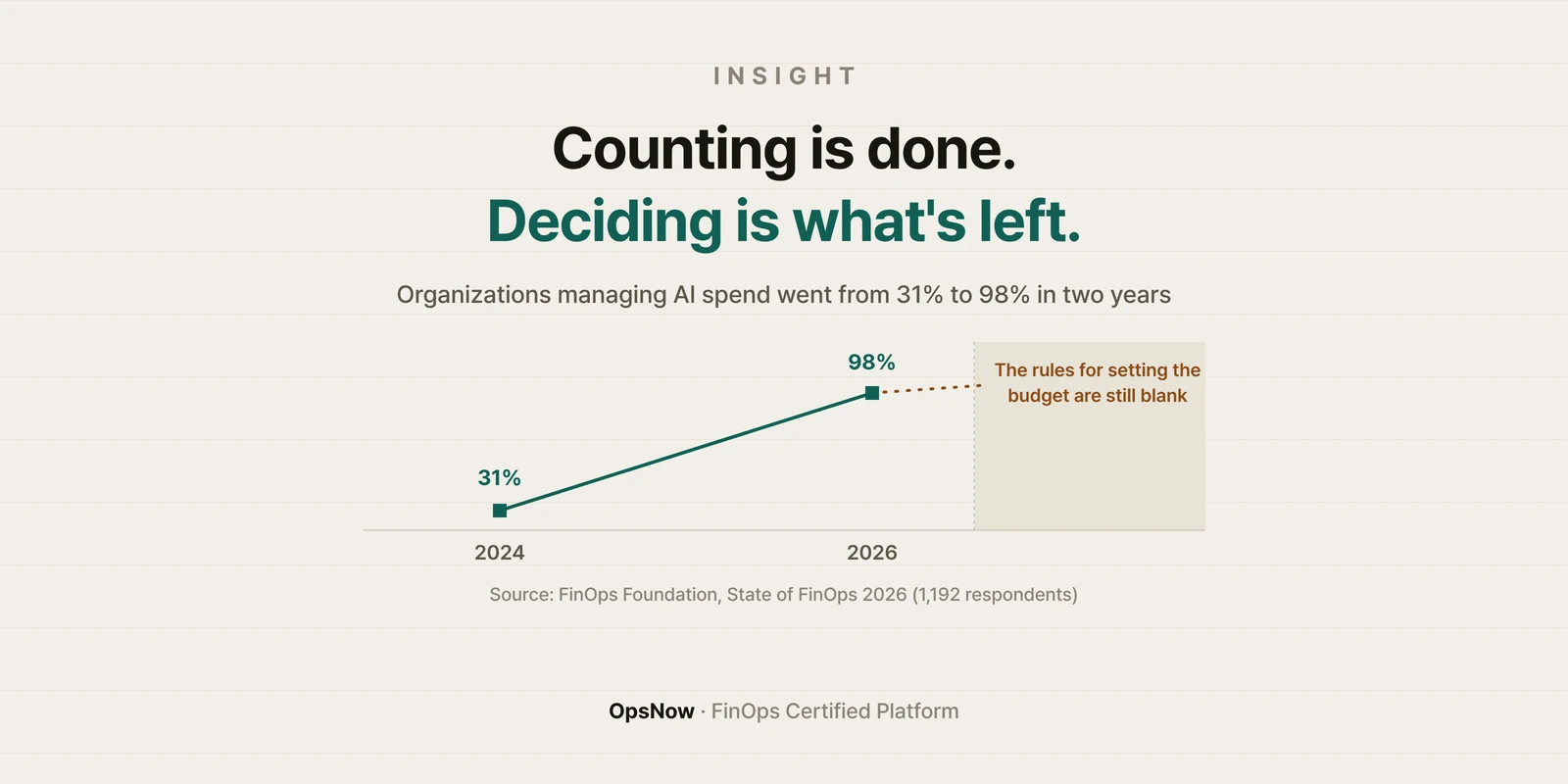
Insight banner: counting is done, deciding is what's left. Line chart of organizations managing AI spend rising from 31% in 2024 to 98% in 2026
Insight

98% Now Manage AI Spend. The Hard Part Is Setting the Budget

OpsNow Team
2026-09-17

■ Problem: In two years, almost every organization has started tracking AI spend. But who decides how much can be spent is still unclear.

■ Solution: Separate the job from measurement. Decide who owns budget limits, who owns enforcement and who translates between them, and shorten the forecast cycle.

■ Result: The meeting that asks "How much did we spend this month?" becomes the meeting that decides "How much can we spend next quarter?"

At a quarterly planning meeting, an executive asks: "How much should we set aside for AI next year?" The dashboard shows last month's GPU usage, hour by hour. The person presenting scrolls down twice and stops. The data is there. What's missing is a rule for turning those numbers into next year's budget.

AI cost management is already the norm

The FinOps Foundation's State of FinOps 2026 surveyed 1,192 respondents representing more than $83 billion in annual cloud spend. 98% of them said they manage AI spend. In 2024 that figure was 31%. It got there in two years.

The scope of FinOps has grown along with it. SaaS is at 90%, licensing at 64%. Data centers and labor costs are on the list now too.

So the "we don't know what AI is costing us" stage is over. Tagging spend and breaking it down by team is close to standard practice.
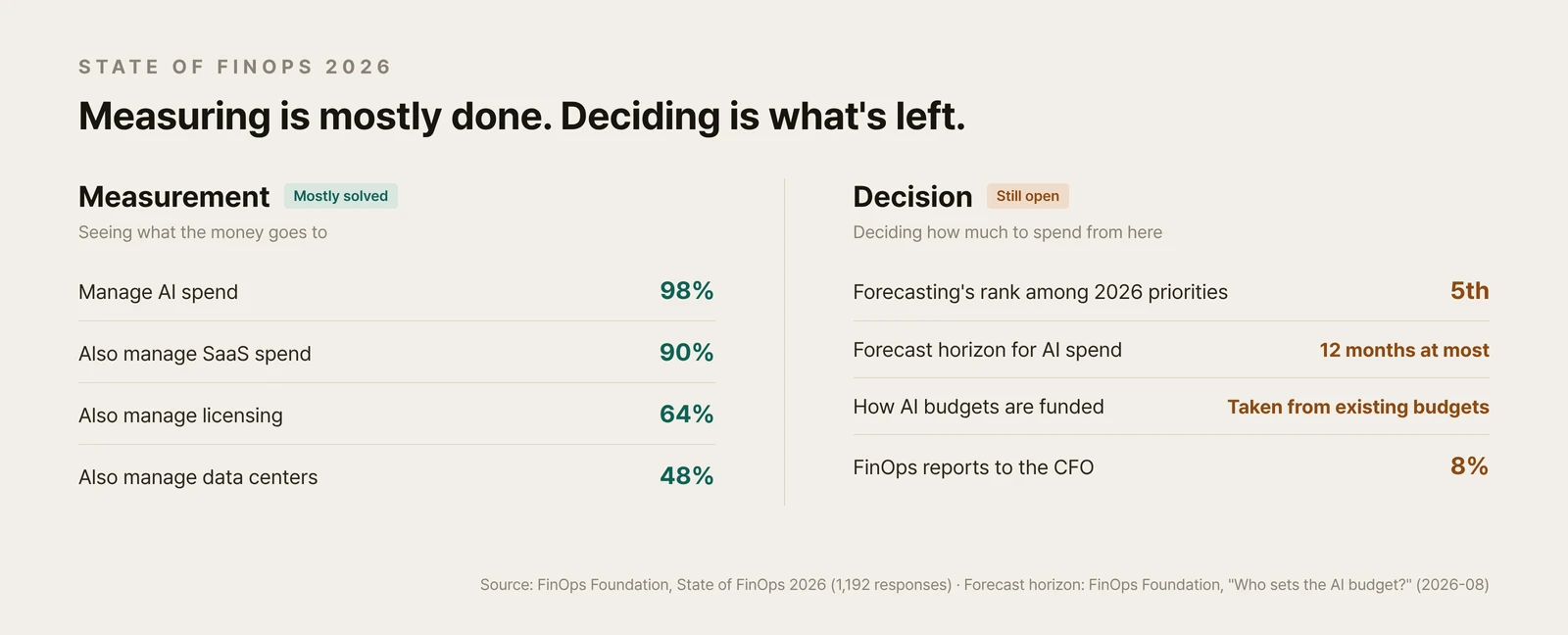
Concept diagram contrasting measurement, which is now widespread, with decision-making, which is not
Most of the measurement items are solved. The decision items are what's left (Source: State of FinOps 2026)

Yet forecasting ranks fifth

In the same survey, the 2026 priorities were workload optimization and waste reduction, expanding technology scope, governance and policy, and organizational alignment, in that order. Forecasting comes after them.

The first four deal with money already being spent. Only forecasting deals with money yet to be spent.

The FinOps Foundation sees the forecasting horizon for AI spend as short, around 12 months at most. Models and pricing change often, and many projects are still experiments.

AI budgets don't grow the total

Departments already hold budgets for people, software and infrastructure. Instead of growing the total, AI is asked to fund itself by cutting one of them. So AI budget meetings soon turn into allocation fights. When the evidence is thin, the loudest voice wins.

The FinOps Foundation's answer is to split the roles. Finance sets limits and tolerances, engineering turns them into enforceable controls, and FinOps translates between the two.

The org chart matters too. 78% of FinOps teams reported to a CTO or CIO, and only 8% reported to a CFO.

Still, teams with executive involvement showed two to three times more influence on decisions than those without. Involvement matters more than reporting line.

Three things you can do now

  • Define the unit before the total. Not "this much a month on AI," but cost per 1,000 inferences or per active user.
  • Break the budget into quarters. If the forecast horizon is 12 months, an annual number locked in today is mostly a guess.
  • Bring executives into the meeting where the criteria are set. That's not the same as handing them a finished report.

Where OpsNow helps

OpsNow FinOps brings together features for the decision side. Budgets uses AI cost forecasting and sends alerts at 80/90/100% thresholds on hierarchical budgets. Cost Allocation uses Shared Cost Rules to distribute shared costs so that 100% of spend is allocated, and GPU cloud management covers utilization, usage-based metering and team quotas. That's where the inputs for the units above come from.

Because cost data from five CSPs (AWS, Azure, GCP, OCI and Naver Cloud) sits on one basis, the budget discussion happens at one table even when environments are split.

Back to the quarterly planning meeting. What that room needs isn't last month's usage screen. It needs next quarter's limit, and an alert that goes off when spending crosses it.

▶ Talk to OpsNow about your cloud costs

Frequently Asked Questions

Q. Should AI costs be managed separately from cloud costs?

They don't need a separate view, but you do need to be able to count them separately, because the budget owner is often different. Managing them on the same platform is fine as long as AI items like GPUs and inference can be broken out.

Q. If forecasting is hard, how do we set a budget?

Shorten the period. The FinOps Foundation sees the forecasting horizon for AI spend as about 12 months at most. Rather than locking in an annual figure, set quarterly limits and adjust with threshold alerts.

Q. How do we define unit economics for AI costs?

Attach them to something the business already counts: inferences, active users, documents or tickets processed. Any quantity the business side understands works. Picking one unit and watching its trend each quarter beats hunting for a perfect one.

Q. Is a FinOps team under the CTO at a disadvantage in budget discussions?

Involvement matters more than reporting line. In State of FinOps 2026, 78% reported to a CTO or CIO, and teams with real executive involvement had two to three times more influence on decisions.

Get Started Today with OpsNow

Insight banner: counting is done, deciding is what's left. Line chart of organizations managing AI spend rising from 31% in 2024 to 98% in 2026
Insight

98% Now Manage AI Spend. The Hard Part Is Setting the Budget

OpsNow Team
2026-09-17

■ Problem: In two years, almost every organization has started tracking AI spend. But who decides how much can be spent is still unclear.

■ Solution: Separate the job from measurement. Decide who owns budget limits, who owns enforcement and who translates between them, and shorten the forecast cycle.

■ Result: The meeting that asks "How much did we spend this month?" becomes the meeting that decides "How much can we spend next quarter?"

At a quarterly planning meeting, an executive asks: "How much should we set aside for AI next year?" The dashboard shows last month's GPU usage, hour by hour. The person presenting scrolls down twice and stops. The data is there. What's missing is a rule for turning those numbers into next year's budget.

AI cost management is already the norm

The FinOps Foundation's State of FinOps 2026 surveyed 1,192 respondents representing more than $83 billion in annual cloud spend. 98% of them said they manage AI spend. In 2024 that figure was 31%. It got there in two years.

The scope of FinOps has grown along with it. SaaS is at 90%, licensing at 64%. Data centers and labor costs are on the list now too.

So the "we don't know what AI is costing us" stage is over. Tagging spend and breaking it down by team is close to standard practice.

Concept diagram contrasting measurement, which is now widespread, with decision-making, which is not
Most of the measurement items are solved. The decision items are what's left (Source: State of FinOps 2026)

Yet forecasting ranks fifth

In the same survey, the 2026 priorities were workload optimization and waste reduction, expanding technology scope, governance and policy, and organizational alignment, in that order. Forecasting comes after them.

The first four deal with money already being spent. Only forecasting deals with money yet to be spent.

The FinOps Foundation sees the forecasting horizon for AI spend as short, around 12 months at most. Models and pricing change often, and many projects are still experiments.

AI budgets don't grow the total

Departments already hold budgets for people, software and infrastructure. Instead of growing the total, AI is asked to fund itself by cutting one of them. So AI budget meetings soon turn into allocation fights. When the evidence is thin, the loudest voice wins.

The FinOps Foundation's answer is to split the roles. Finance sets limits and tolerances, engineering turns them into enforceable controls, and FinOps translates between the two.

The org chart matters too. 78% of FinOps teams reported to a CTO or CIO, and only 8% reported to a CFO.

Still, teams with executive involvement showed two to three times more influence on decisions than those without. Involvement matters more than reporting line.

Three things you can do now

  • Define the unit before the total. Not "this much a month on AI," but cost per 1,000 inferences or per active user.
  • Break the budget into quarters. If the forecast horizon is 12 months, an annual number locked in today is mostly a guess.
  • Bring executives into the meeting where the criteria are set. That's not the same as handing them a finished report.

Where OpsNow helps

OpsNow FinOps brings together features for the decision side. Budgets uses AI cost forecasting and sends alerts at 80/90/100% thresholds on hierarchical budgets. Cost Allocation uses Shared Cost Rules to distribute shared costs so that 100% of spend is allocated, and GPU cloud management covers utilization, usage-based metering and team quotas. That's where the inputs for the units above come from.

Because cost data from five CSPs (AWS, Azure, GCP, OCI and Naver Cloud) sits on one basis, the budget discussion happens at one table even when environments are split.

Back to the quarterly planning meeting. What that room needs isn't last month's usage screen. It needs next quarter's limit, and an alert that goes off when spending crosses it.

▶ Talk to OpsNow about your cloud costs

Frequently Asked Questions

Q. Should AI costs be managed separately from cloud costs?

They don't need a separate view, but you do need to be able to count them separately, because the budget owner is often different. Managing them on the same platform is fine as long as AI items like GPUs and inference can be broken out.

Q. If forecasting is hard, how do we set a budget?

Shorten the period. The FinOps Foundation sees the forecasting horizon for AI spend as about 12 months at most. Rather than locking in an annual figure, set quarterly limits and adjust with threshold alerts.

Q. How do we define unit economics for AI costs?

Attach them to something the business already counts: inferences, active users, documents or tickets processed. Any quantity the business side understands works. Picking one unit and watching its trend each quarter beats hunting for a perfect one.

Q. Is a FinOps team under the CTO at a disadvantage in budget discussions?

Involvement matters more than reporting line. In State of FinOps 2026, 78% reported to a CTO or CIO, and teams with real executive involvement had two to three times more influence on decisions.

98% Now Manage AI Spend. The Hard Part Is Setting the Budget

■ Problem: In two years, almost every organization has started tracking AI spend. But who decides how much can be spent is still unclear.

■ Solution: Separate the job from measurement. Decide who owns budget limits, who owns enforcement and who translates between them, and shorten the forecast cycle.

■ Result: The meeting that asks "How much did we spend this month?" becomes the meeting that decides "How much can we spend next quarter?"

At a quarterly planning meeting, an executive asks: "How much should we set aside for AI next year?" The dashboard shows last month's GPU usage, hour by hour. The person presenting scrolls down twice and stops. The data is there. What's missing is a rule for turning those numbers into next year's budget.

AI cost management is already the norm

The FinOps Foundation's State of FinOps 2026 surveyed 1,192 respondents representing more than $83 billion in annual cloud spend. 98% of them said they manage AI spend. In 2024 that figure was 31%. It got there in two years.

The scope of FinOps has grown along with it. SaaS is at 90%, licensing at 64%. Data centers and labor costs are on the list now too.

So the "we don't know what AI is costing us" stage is over. Tagging spend and breaking it down by team is close to standard practice.

Concept diagram contrasting measurement, which is now widespread, with decision-making, which is not
Most of the measurement items are solved. The decision items are what's left (Source: State of FinOps 2026)

Yet forecasting ranks fifth

In the same survey, the 2026 priorities were workload optimization and waste reduction, expanding technology scope, governance and policy, and organizational alignment, in that order. Forecasting comes after them.

The first four deal with money already being spent. Only forecasting deals with money yet to be spent.

The FinOps Foundation sees the forecasting horizon for AI spend as short, around 12 months at most. Models and pricing change often, and many projects are still experiments.

AI budgets don't grow the total

Departments already hold budgets for people, software and infrastructure. Instead of growing the total, AI is asked to fund itself by cutting one of them. So AI budget meetings soon turn into allocation fights. When the evidence is thin, the loudest voice wins.

The FinOps Foundation's answer is to split the roles. Finance sets limits and tolerances, engineering turns them into enforceable controls, and FinOps translates between the two.

The org chart matters too. 78% of FinOps teams reported to a CTO or CIO, and only 8% reported to a CFO.

Still, teams with executive involvement showed two to three times more influence on decisions than those without. Involvement matters more than reporting line.

Three things you can do now

  • Define the unit before the total. Not "this much a month on AI," but cost per 1,000 inferences or per active user.
  • Break the budget into quarters. If the forecast horizon is 12 months, an annual number locked in today is mostly a guess.
  • Bring executives into the meeting where the criteria are set. That's not the same as handing them a finished report.

Where OpsNow helps

OpsNow FinOps brings together features for the decision side. Budgets uses AI cost forecasting and sends alerts at 80/90/100% thresholds on hierarchical budgets. Cost Allocation uses Shared Cost Rules to distribute shared costs so that 100% of spend is allocated, and GPU cloud management covers utilization, usage-based metering and team quotas. That's where the inputs for the units above come from.

Because cost data from five CSPs (AWS, Azure, GCP, OCI and Naver Cloud) sits on one basis, the budget discussion happens at one table even when environments are split.

Back to the quarterly planning meeting. What that room needs isn't last month's usage screen. It needs next quarter's limit, and an alert that goes off when spending crosses it.

▶ Talk to OpsNow about your cloud costs

Frequently Asked Questions

Q. Should AI costs be managed separately from cloud costs?

They don't need a separate view, but you do need to be able to count them separately, because the budget owner is often different. Managing them on the same platform is fine as long as AI items like GPUs and inference can be broken out.

Q. If forecasting is hard, how do we set a budget?

Shorten the period. The FinOps Foundation sees the forecasting horizon for AI spend as about 12 months at most. Rather than locking in an annual figure, set quarterly limits and adjust with threshold alerts.

Q. How do we define unit economics for AI costs?

Attach them to something the business already counts: inferences, active users, documents or tickets processed. Any quantity the business side understands works. Picking one unit and watching its trend each quarter beats hunting for a perfect one.

Q. Is a FinOps team under the CTO at a disadvantage in budget discussions?

Involvement matters more than reporting line. In State of FinOps 2026, 78% reported to a CTO or CIO, and teams with real executive involvement had two to three times more influence on decisions.
Download it for free
Submit the information below and get the files you need right away
Name *
Company *
Business Email *
By registering an inquiry, you agree to allow OpsNow to store and process your information for contact purposes.
Please read our Privacy Policy for more information.
Thank you.
The file has been downloaded.
Please enter all required fields.
Insight banner: counting is done, deciding is what's left. Line chart of organizations managing AI spend rising from 31% in 2024 to 98% in 2026

98% Now Manage AI Spend. The Hard Part Is Setting the Budget

OpsNow Team
2026-09-17

■ Problem: In two years, almost every organization has started tracking AI spend. But who decides how much can be spent is still unclear.

■ Solution: Separate the job from measurement. Decide who owns budget limits, who owns enforcement and who translates between them, and shorten the forecast cycle.

■ Result: The meeting that asks "How much did we spend this month?" becomes the meeting that decides "How much can we spend next quarter?"

At a quarterly planning meeting, an executive asks: "How much should we set aside for AI next year?" The dashboard shows last month's GPU usage, hour by hour. The person presenting scrolls down twice and stops. The data is there. What's missing is a rule for turning those numbers into next year's budget.

AI cost management is already the norm

The FinOps Foundation's State of FinOps 2026 surveyed 1,192 respondents representing more than $83 billion in annual cloud spend. 98% of them said they manage AI spend. In 2024 that figure was 31%. It got there in two years.

The scope of FinOps has grown along with it. SaaS is at 90%, licensing at 64%. Data centers and labor costs are on the list now too.

So the "we don't know what AI is costing us" stage is over. Tagging spend and breaking it down by team is close to standard practice.

Concept diagram contrasting measurement, which is now widespread, with decision-making, which is not
Most of the measurement items are solved. The decision items are what's left (Source: State of FinOps 2026)

Yet forecasting ranks fifth

In the same survey, the 2026 priorities were workload optimization and waste reduction, expanding technology scope, governance and policy, and organizational alignment, in that order. Forecasting comes after them.

The first four deal with money already being spent. Only forecasting deals with money yet to be spent.

The FinOps Foundation sees the forecasting horizon for AI spend as short, around 12 months at most. Models and pricing change often, and many projects are still experiments.

AI budgets don't grow the total

Departments already hold budgets for people, software and infrastructure. Instead of growing the total, AI is asked to fund itself by cutting one of them. So AI budget meetings soon turn into allocation fights. When the evidence is thin, the loudest voice wins.

The FinOps Foundation's answer is to split the roles. Finance sets limits and tolerances, engineering turns them into enforceable controls, and FinOps translates between the two.

The org chart matters too. 78% of FinOps teams reported to a CTO or CIO, and only 8% reported to a CFO.

Still, teams with executive involvement showed two to three times more influence on decisions than those without. Involvement matters more than reporting line.

Three things you can do now

  • Define the unit before the total. Not "this much a month on AI," but cost per 1,000 inferences or per active user.
  • Break the budget into quarters. If the forecast horizon is 12 months, an annual number locked in today is mostly a guess.
  • Bring executives into the meeting where the criteria are set. That's not the same as handing them a finished report.

Where OpsNow helps

OpsNow FinOps brings together features for the decision side. Budgets uses AI cost forecasting and sends alerts at 80/90/100% thresholds on hierarchical budgets. Cost Allocation uses Shared Cost Rules to distribute shared costs so that 100% of spend is allocated, and GPU cloud management covers utilization, usage-based metering and team quotas. That's where the inputs for the units above come from.

Because cost data from five CSPs (AWS, Azure, GCP, OCI and Naver Cloud) sits on one basis, the budget discussion happens at one table even when environments are split.

Back to the quarterly planning meeting. What that room needs isn't last month's usage screen. It needs next quarter's limit, and an alert that goes off when spending crosses it.

▶ Talk to OpsNow about your cloud costs

Frequently Asked Questions

Q. Should AI costs be managed separately from cloud costs?

They don't need a separate view, but you do need to be able to count them separately, because the budget owner is often different. Managing them on the same platform is fine as long as AI items like GPUs and inference can be broken out.

Q. If forecasting is hard, how do we set a budget?

Shorten the period. The FinOps Foundation sees the forecasting horizon for AI spend as about 12 months at most. Rather than locking in an annual figure, set quarterly limits and adjust with threshold alerts.

Q. How do we define unit economics for AI costs?

Attach them to something the business already counts: inferences, active users, documents or tickets processed. Any quantity the business side understands works. Picking one unit and watching its trend each quarter beats hunting for a perfect one.

Q. Is a FinOps team under the CTO at a disadvantage in budget discussions?

Involvement matters more than reporting line. In State of FinOps 2026, 78% reported to a CTO or CIO, and teams with real executive involvement had two to three times more influence on decisions.

98% Now Manage AI Spend. The Hard Part Is Setting the Budget

OpsNow Team
2026-09-17

■ Problem: In two years, almost every organization has started tracking AI spend. But who decides how much can be spent is still unclear.

■ Solution: Separate the job from measurement. Decide who owns budget limits, who owns enforcement and who translates between them, and shorten the forecast cycle.

■ Result: The meeting that asks "How much did we spend this month?" becomes the meeting that decides "How much can we spend next quarter?"

At a quarterly planning meeting, an executive asks: "How much should we set aside for AI next year?" The dashboard shows last month's GPU usage, hour by hour. The person presenting scrolls down twice and stops. The data is there. What's missing is a rule for turning those numbers into next year's budget.

AI cost management is already the norm

The FinOps Foundation's State of FinOps 2026 surveyed 1,192 respondents representing more than $83 billion in annual cloud spend. 98% of them said they manage AI spend. In 2024 that figure was 31%. It got there in two years.

The scope of FinOps has grown along with it. SaaS is at 90%, licensing at 64%. Data centers and labor costs are on the list now too.

So the "we don't know what AI is costing us" stage is over. Tagging spend and breaking it down by team is close to standard practice.

Concept diagram contrasting measurement, which is now widespread, with decision-making, which is not
Most of the measurement items are solved. The decision items are what's left (Source: State of FinOps 2026)

Yet forecasting ranks fifth

In the same survey, the 2026 priorities were workload optimization and waste reduction, expanding technology scope, governance and policy, and organizational alignment, in that order. Forecasting comes after them.

The first four deal with money already being spent. Only forecasting deals with money yet to be spent.

The FinOps Foundation sees the forecasting horizon for AI spend as short, around 12 months at most. Models and pricing change often, and many projects are still experiments.

AI budgets don't grow the total

Departments already hold budgets for people, software and infrastructure. Instead of growing the total, AI is asked to fund itself by cutting one of them. So AI budget meetings soon turn into allocation fights. When the evidence is thin, the loudest voice wins.

The FinOps Foundation's answer is to split the roles. Finance sets limits and tolerances, engineering turns them into enforceable controls, and FinOps translates between the two.

The org chart matters too. 78% of FinOps teams reported to a CTO or CIO, and only 8% reported to a CFO.

Still, teams with executive involvement showed two to three times more influence on decisions than those without. Involvement matters more than reporting line.

Three things you can do now

  • Define the unit before the total. Not "this much a month on AI," but cost per 1,000 inferences or per active user.
  • Break the budget into quarters. If the forecast horizon is 12 months, an annual number locked in today is mostly a guess.
  • Bring executives into the meeting where the criteria are set. That's not the same as handing them a finished report.

Where OpsNow helps

OpsNow FinOps brings together features for the decision side. Budgets uses AI cost forecasting and sends alerts at 80/90/100% thresholds on hierarchical budgets. Cost Allocation uses Shared Cost Rules to distribute shared costs so that 100% of spend is allocated, and GPU cloud management covers utilization, usage-based metering and team quotas. That's where the inputs for the units above come from.

Because cost data from five CSPs (AWS, Azure, GCP, OCI and Naver Cloud) sits on one basis, the budget discussion happens at one table even when environments are split.

Back to the quarterly planning meeting. What that room needs isn't last month's usage screen. It needs next quarter's limit, and an alert that goes off when spending crosses it.

▶ Talk to OpsNow about your cloud costs

Frequently Asked Questions

Q. Should AI costs be managed separately from cloud costs?

They don't need a separate view, but you do need to be able to count them separately, because the budget owner is often different. Managing them on the same platform is fine as long as AI items like GPUs and inference can be broken out.

Q. If forecasting is hard, how do we set a budget?

Shorten the period. The FinOps Foundation sees the forecasting horizon for AI spend as about 12 months at most. Rather than locking in an annual figure, set quarterly limits and adjust with threshold alerts.

Q. How do we define unit economics for AI costs?

Attach them to something the business already counts: inferences, active users, documents or tickets processed. Any quantity the business side understands works. Picking one unit and watching its trend each quarter beats hunting for a perfect one.

Q. Is a FinOps team under the CTO at a disadvantage in budget discussions?

Involvement matters more than reporting line. In State of FinOps 2026, 78% reported to a CTO or CIO, and teams with real executive involvement had two to three times more influence on decisions.

Insight banner: counting is done, deciding is what's left. Line chart of organizations managing AI spend rising from 31% in 2024 to 98% in 2026
Insight

98% Now Manage AI Spend. The Hard Part Is Setting the Budget

OpsNow Team
2026-09-17

■ Problem: In two years, almost every organization has started tracking AI spend. But who decides how much can be spent is still unclear.

■ Solution: Separate the job from measurement. Decide who owns budget limits, who owns enforcement and who translates between them, and shorten the forecast cycle.

■ Result: The meeting that asks "How much did we spend this month?" becomes the meeting that decides "How much can we spend next quarter?"

At a quarterly planning meeting, an executive asks: "How much should we set aside for AI next year?" The dashboard shows last month's GPU usage, hour by hour. The person presenting scrolls down twice and stops. The data is there. What's missing is a rule for turning those numbers into next year's budget.

AI cost management is already the norm

The FinOps Foundation's State of FinOps 2026 surveyed 1,192 respondents representing more than $83 billion in annual cloud spend. 98% of them said they manage AI spend. In 2024 that figure was 31%. It got there in two years.

The scope of FinOps has grown along with it. SaaS is at 90%, licensing at 64%. Data centers and labor costs are on the list now too.

So the "we don't know what AI is costing us" stage is over. Tagging spend and breaking it down by team is close to standard practice.

Concept diagram contrasting measurement, which is now widespread, with decision-making, which is not
Most of the measurement items are solved. The decision items are what's left (Source: State of FinOps 2026)

Yet forecasting ranks fifth

In the same survey, the 2026 priorities were workload optimization and waste reduction, expanding technology scope, governance and policy, and organizational alignment, in that order. Forecasting comes after them.

The first four deal with money already being spent. Only forecasting deals with money yet to be spent.

The FinOps Foundation sees the forecasting horizon for AI spend as short, around 12 months at most. Models and pricing change often, and many projects are still experiments.

AI budgets don't grow the total

Departments already hold budgets for people, software and infrastructure. Instead of growing the total, AI is asked to fund itself by cutting one of them. So AI budget meetings soon turn into allocation fights. When the evidence is thin, the loudest voice wins.

The FinOps Foundation's answer is to split the roles. Finance sets limits and tolerances, engineering turns them into enforceable controls, and FinOps translates between the two.

The org chart matters too. 78% of FinOps teams reported to a CTO or CIO, and only 8% reported to a CFO.

Still, teams with executive involvement showed two to three times more influence on decisions than those without. Involvement matters more than reporting line.

Three things you can do now

  • Define the unit before the total. Not "this much a month on AI," but cost per 1,000 inferences or per active user.
  • Break the budget into quarters. If the forecast horizon is 12 months, an annual number locked in today is mostly a guess.
  • Bring executives into the meeting where the criteria are set. That's not the same as handing them a finished report.

Where OpsNow helps

OpsNow FinOps brings together features for the decision side. Budgets uses AI cost forecasting and sends alerts at 80/90/100% thresholds on hierarchical budgets. Cost Allocation uses Shared Cost Rules to distribute shared costs so that 100% of spend is allocated, and GPU cloud management covers utilization, usage-based metering and team quotas. That's where the inputs for the units above come from.

Because cost data from five CSPs (AWS, Azure, GCP, OCI and Naver Cloud) sits on one basis, the budget discussion happens at one table even when environments are split.

Back to the quarterly planning meeting. What that room needs isn't last month's usage screen. It needs next quarter's limit, and an alert that goes off when spending crosses it.

▶ Talk to OpsNow about your cloud costs

Frequently Asked Questions

Q. Should AI costs be managed separately from cloud costs?

They don't need a separate view, but you do need to be able to count them separately, because the budget owner is often different. Managing them on the same platform is fine as long as AI items like GPUs and inference can be broken out.

Q. If forecasting is hard, how do we set a budget?

Shorten the period. The FinOps Foundation sees the forecasting horizon for AI spend as about 12 months at most. Rather than locking in an annual figure, set quarterly limits and adjust with threshold alerts.

Q. How do we define unit economics for AI costs?

Attach them to something the business already counts: inferences, active users, documents or tickets processed. Any quantity the business side understands works. Picking one unit and watching its trend each quarter beats hunting for a perfect one.

Q. Is a FinOps team under the CTO at a disadvantage in budget discussions?

Involvement matters more than reporting line. In State of FinOps 2026, 78% reported to a CTO or CIO, and teams with real executive involvement had two to three times more influence on decisions.